Community Building
- Early demand generation
- Community-led Branding
Case Study
Selected Work
Bootstrapping Kawan as a solo founder. Leading end-to-end execution across product strategy, UX/UI design, branding, growth, and community building.
Role
Solo Founder (Product Management, Product Design, Branding, Marketing, Ops)
Sector
B2C | Social marketplace | Entrepreneurship
Scope
End-to-end product & venture development

Kawan helps people find companions for concerts, parties, and other events they would otherwise skip.
Context
Based on my own experience of skipping concerts because none of my friends were interested, and after discovering that many others faced the same issue, I founded Kawan to solve this problem. As a product builder, I lead the venture end-to-end, from problem discovery and validation to product development, branding, distribution, growth, and community building.
Impact
1,100+ community members and early users achieved with minimal marketing budget.
80% profile completion rate, with 40% of users creating a buddy request within one hour of registration
48% activation rate, defined as the percentage of registered users completing the core action.
100+ groups matched
Metrics as of June 2026.
Key Activities
Milestones
This is a snapshot of Kawan's journey so far, highlighting the progress, setbacks, and lessons learned up to June 2026.
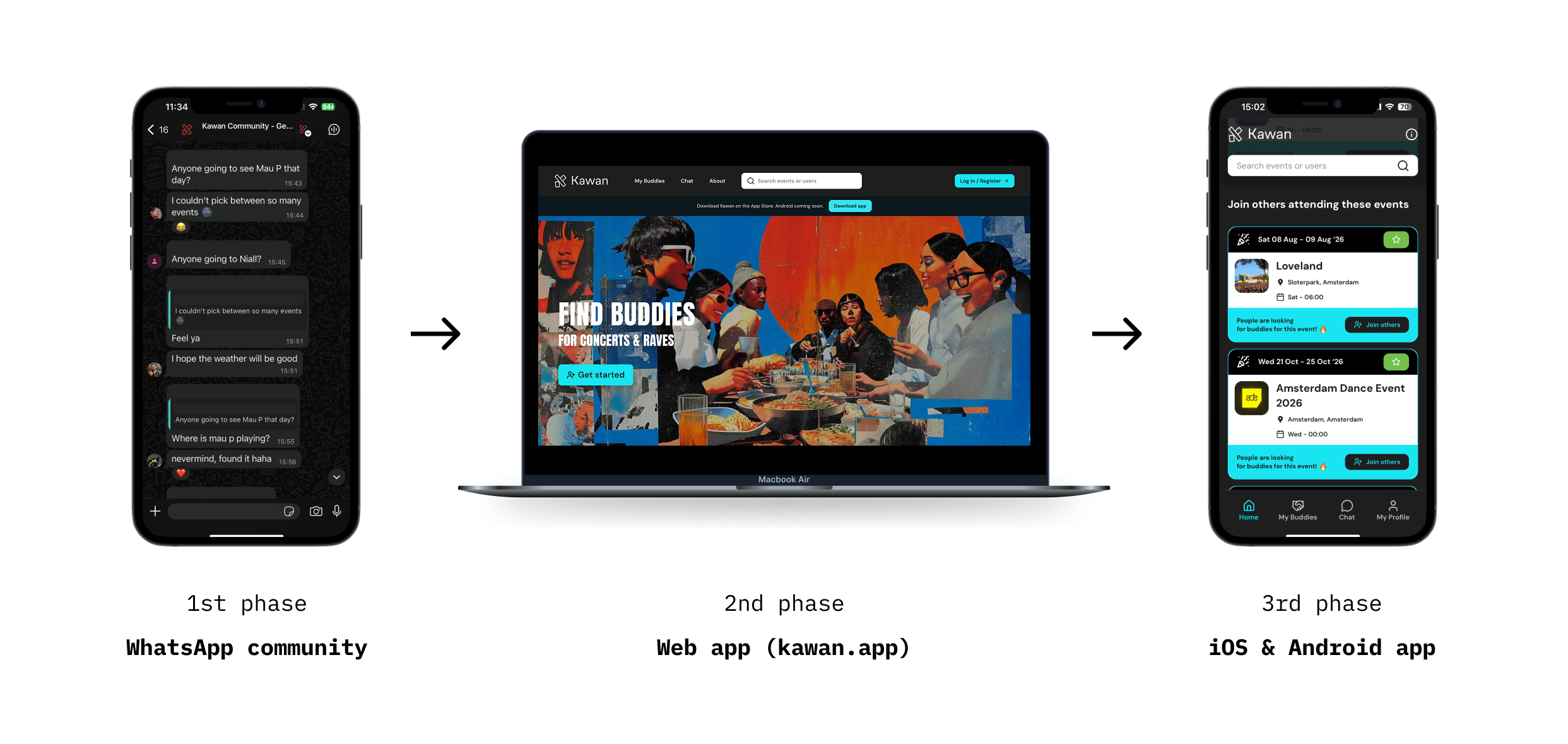
As a solo founder with no external funding, I built Kawan in phases to reduce risk and validate demand before investing in technology.
The journey started with research and user interviews, where I discovered that many people skip concerts and events simply because they have no one to go with. To test whether this problem was worth solving, I launched a WhatsApp community instead of building an app right away. The community grew to over 700 members across the Netherlands and successfully helped people find event companions.
After validating the demand, I designed the end-to-end user experience, hired a remote development agency, and led the development of the first MVP as Product Manager. To keep costs low and move quickly, we launched as a web application. This proved that the behaviour and interactions happening in WhatsApp could successfully be translated into a digital product experience.
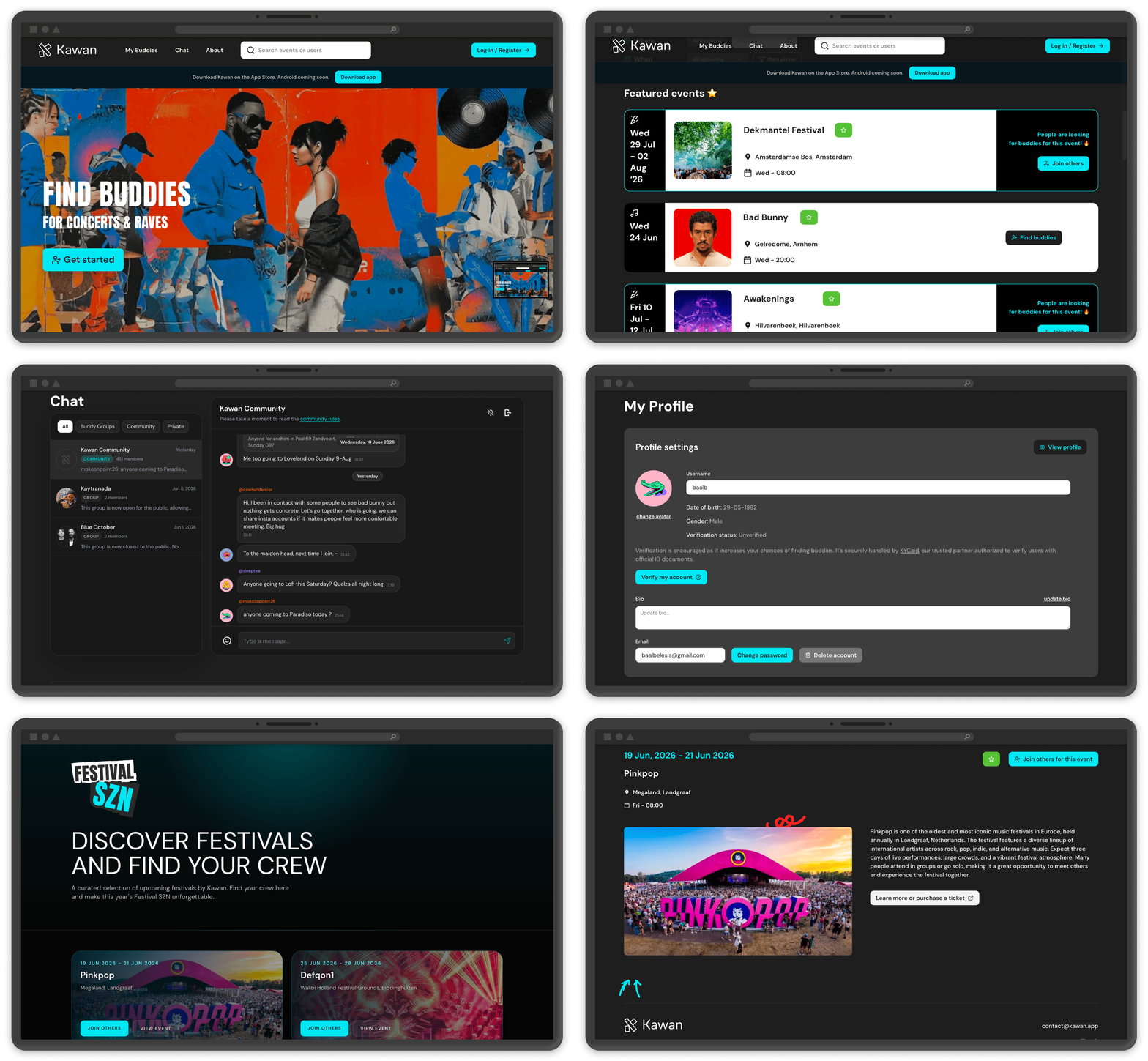
The web app as an MVP to validate product experience
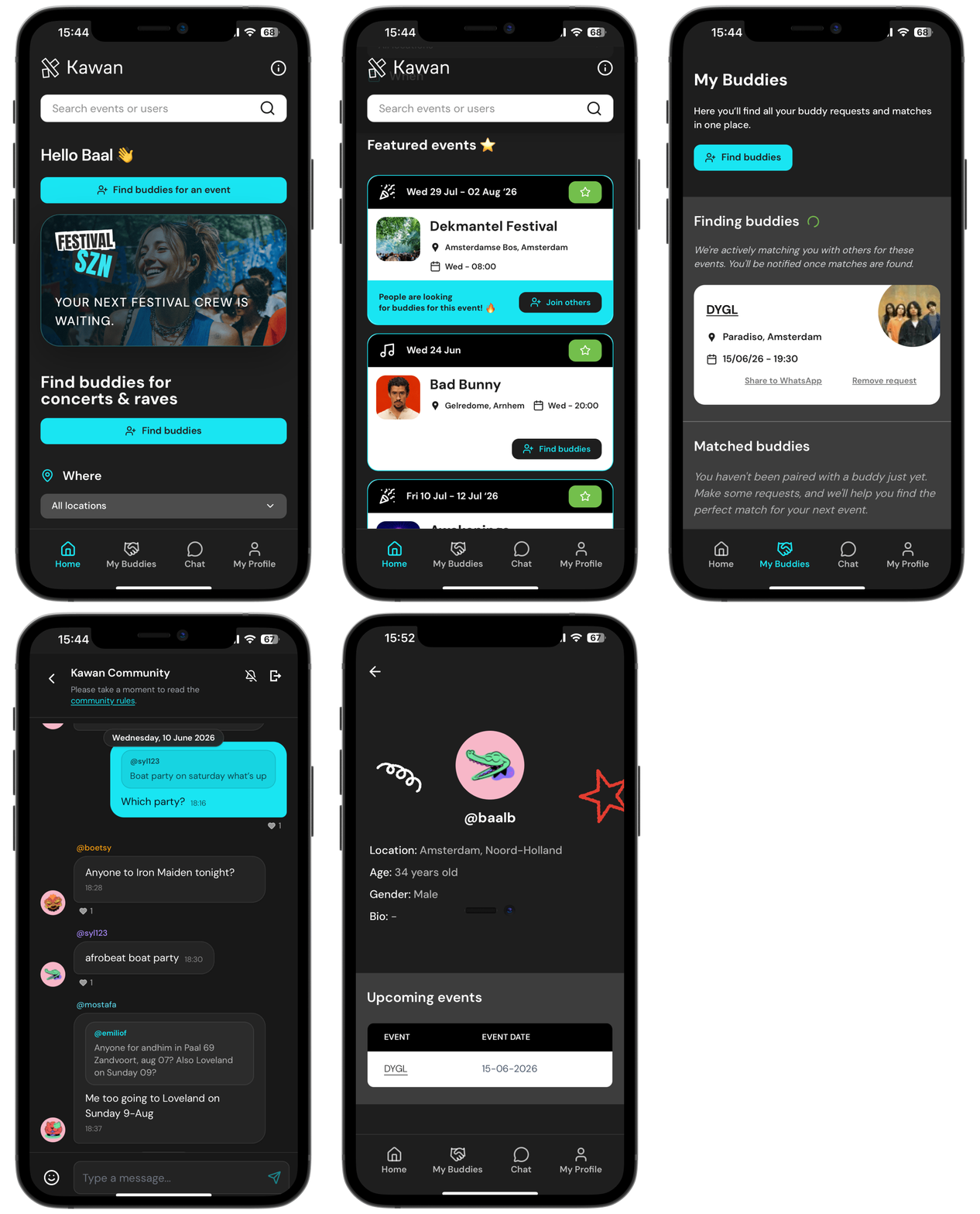
Following the MVP launch, I used AI-assisted development tools to rapidly iterate and improve the product, significantly increasing user activation and engagement. I later built and launched the native iOS app myself, transforming the experience from a web-based MVP into a polished mobile product.
When Kawan first launched, only around 8% of users used the product's core feature: creating a buddy request for an event. Most users registered but never took the next step.
By analysing user behaviour and feedback, I identified several friction points in the onboarding and activation experience. The biggest improvements did not come from redesigning entire flows, but from dozens of smaller iterations: refining microcopy, improving trust and marketplace perception, making existing groups more visible, and helping users better understand how the platform worked.
As a bootstrapped founder, I could no longer rely on a development agency for every update. To move faster, I learned how to work directly with the codebase using AI-assisted development tools, supported by my fractional tech advisor. This allowed me to rapidly test, ship, and validate improvements without spending a dime on development costs.
The result was a significant increase in activation and engagement. Profile completion reached 80%, activation increased from 8% to 48%, and 40% of activated users created a buddy request within one hour of registering.
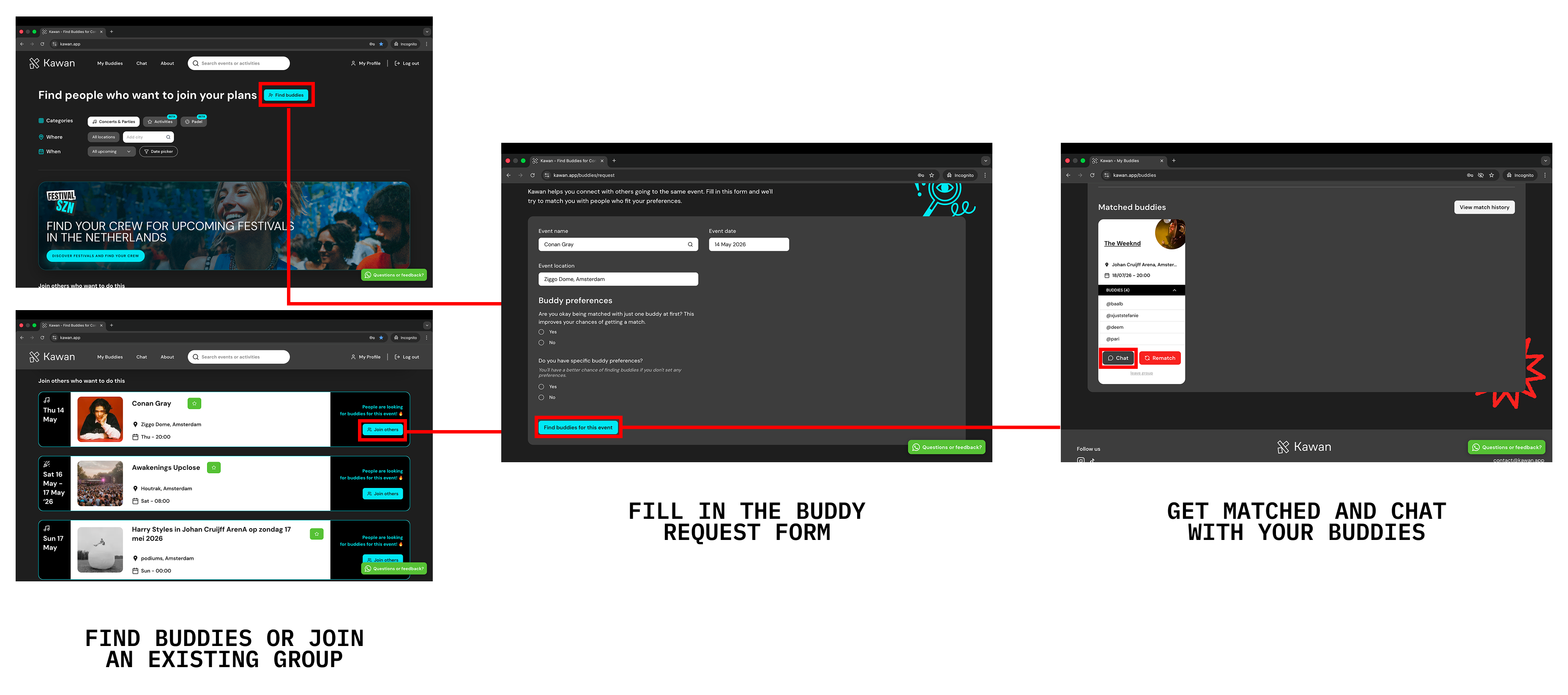
Three steps to get matched with others to attend concerts and parties
Kawan operates in a uniquely challenging marketplace environment. Unlike traditional marketplaces where demand is concentrated around a single product or category, my users are looking for companions for a specific event, in a specific city, at a specific time. This challenge is amplified in the Netherlands, where hundreds of concerts, festivals, parties, and cultural events take place every day. Rather than competing for a single pool of demand, the platform must create matches across a constantly changing landscape of events.
As the platform grew, users submitted hundreds of buddy requests across hundreds of events. This created a significant liquidity challenge because, in the beginning, I was not matching people successfully.
For the product to actually work, people need to be matched for the same event. I deliberately focused growth efforts on the biggest concerts and festivals in Amsterdam before expanding to other cities. By concentrating supply and demand within specific geographic and interest clusters, I was able to increase marketplace liquidity and successfully match people into more than 100 groups of up to 4 people.

The Kawan experience